This is a side project that I’ve been working on for a while … trying to bring it back for something.
Working Title: Democracy and Urban Planning: Chomsky, Brown, and Communicative Rationality
Abstract: Communicative rationality in urban planning emerged in the 1960s in response to the failures of comprehensive and rational planning. This emerging rationality promised more inclusive avenues of participation, deliberation, and public input in the urban planning process. However, as debated within the urban planning profession, the tensions between ‘expertise’ and ‘representation’ have never been reconciled. The role of the urban planner sits uneasily with communicative rationality’s promise of local ‘democracy’ in the city. This unease was exacerbated by the ideological transformation of the role of the state, public actors, and the private market beginning in the 1980s. After discussing popular understandings of ‘democracy’ in urban planning, I present a brief genealogy of the communicative rationality literature—from foundational works of Davidoff (1965) to more recent works of Healey (1992), Hillier (2005), and Forester (2006). Then, I engage the works of Noam Chomsky and Wendy Brown, whose writings help elucidate the shortcomings of communicative rationality in the context of a hallowing out of democracy and a reworking of the citizen. I conclude with reflections on power analysis scholarship that attempts to locate democracy in planning.
~What are your thoughts? Help me out in the comments below.~
I’ve found a few interesting journals that I might write for:
Journal of Southeast Asian American Education and Advancement, Purdue University: here.
“The Journal of Southeast Asian American Education and Advancement is an online and freely accessible interdisciplinary journal providing a forum for scholars and writers from diverse fields who share a common interest in Southeast Asian (SEA) Americans and their communities. JSAAEA is an official publication of the National Association for the Education and Advancement of Cambodian, Laotian, and Vietnamese Americans (NAFEA), with support from the Department of Curriculum and Instruction and the College of Education at Purdue University, and Purdue Libraries Scholarly Publishing Services and Purdue University Press” (JSAAEA Editorial Board).
Given the events of the past year and a personal family tragedy, there is a lot I hope to write particularly on the topic of violence against the elderly. I became more aware of aging-in-place needs in the course of the last year, including from a conversation with a volunteer organization.
Journal of Policy History, Cambridge University: here.
“The Journal of Policy History is an interdisciplinary journal concerned with the application of historical perspectives to public policy studies. While seeking to inform scholars interested in policy history, the journal also seeks to inform policy makers through a historical approach to public policy. Its authors, considering public policy primarily in the United States though also in other nations, focus on policy origins and development through historical inquiry, historical analysis of specific policy areas and policy institutions, explorations of continuities and shifts in policy over time, interdisciplinary research into public policy, and comparative historical approaches to the development of public policy” (JPH Editorial Board).
Southeast Asian resettlement policy history, including dispersion policy, and the politics of the U.S. 1980 Refugee Act are some areas of policy history that I’ll be examining. I’m hoping to document some of what I find in a future post.
~What are your thoughts? Help me out in the comments below.~
Imagine the late 1970s. Southeast Asian immigrants are dispersed across the United States. A main actor here is the Federal government itself, intent through a dispersion policy to deconcentrate the incoming population. They operate under the belief that spatial assimilation (and cultural assimilation) is the best trajectory for refugees and their descendants.
In the following two decades, civil society, composed of Southeast Asian families and communities scattered across the States, find their way into ethnic enclaves and ethnic communities—most of which are in California. This was the rise of new communities, despite initial Federal policy.
From the 2000s on, these very communities face market pressures that threaten to disperse them yet again. In the era of hypergentrication and residential displacement, communities are finding that it is the housing market (the product of decades of policies that have failed the working class and communities of color) that threatens family and community cohesion.
I am thinking of Erik Olin Wright and the public sociologists as a loose grounding for this framework, which I explain very simplistically. I would love any thoughts and reading recommendations!
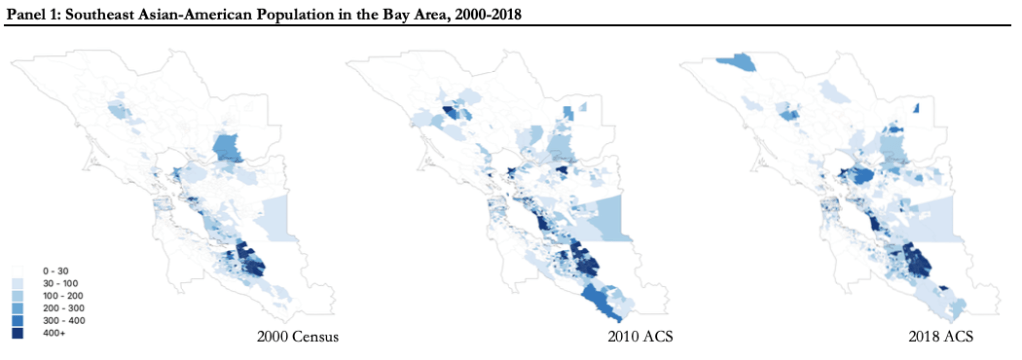
In May 2020, I defended my dissertation proposal, titled “The remaking of Southeast Asian American spaces in the Bay Area Region.” My main concern is to map the Southeast Asian American (SEAA) community of the Bay Area and to study certain neighborhoods and communities. I ask, why have people moved and how has this re-shaped the SEAA communities?
Entrance to the San Francisco Tenderloin Little Saigon business district. Taken January 15, 2020 by Minh Nguyen.
Below is a panel taken out of my proposal. Using public data, I construct maps to show the residential patterns of SEAAs across the Bay Area from 2000 to 2018. In short, my hypothesis is that forces behind hyper-gentrification, resegregation, and racial banishment has led to a dispersal of what I argue are essential communities for the survival and health of the SEAA population. Further, this work will have implications for all in the region, since the outcomes for one community reflects outcomes for everyone else.
Map created by the author, using decennial Census and American Community Survey data.
~What are your thoughts? Help me out in the comments below.~
In a recent Encyclopedia Britannica entry on Human Geography, Johnson (2018) writes about the puzzle of structure and agency. Marxist geographers such as David Harvey have argued that people move alongside capital. According to this theoretical lens, human settlement patterns are part-and-parcel of economic geography. This view has high explanatory power, but some human geographers caution against what they see as an overly deterministic worldview. Doreen Massey, for instance, focuses on human choice and decision—which are at constant interplay with structure and are not merely their outcomes. In short, there is at least some choice in the matter of where people live.
The relevance of this theoretical discussion helps with my reading of Desbarats (1985). At the time of this writing, researchers in the United States were very interested in studying the settlement patterns of newly arrived Southeast Asian persons. Driven by Congressional mandate and also by curiosity in the academy about the life trajectories of refugees from Southeast Asia, studies such as Desbarats’ examine the where and why of migration.
There where is summarized by these maps from Desbarats (1985):
Distribution of Southeast Asian persons in the U.S. 1975, from Desbarats (1985)Distribution of Southeast Asian persons in the U.S. 1981, from Desbarats (1985)
The westward population shift from 1975 to 1985 was a trend that would establish the base for further primary and secondary migration. Explaining the reasons for such migration require a variety of inquiries, including quantitative analysis done with available government data.
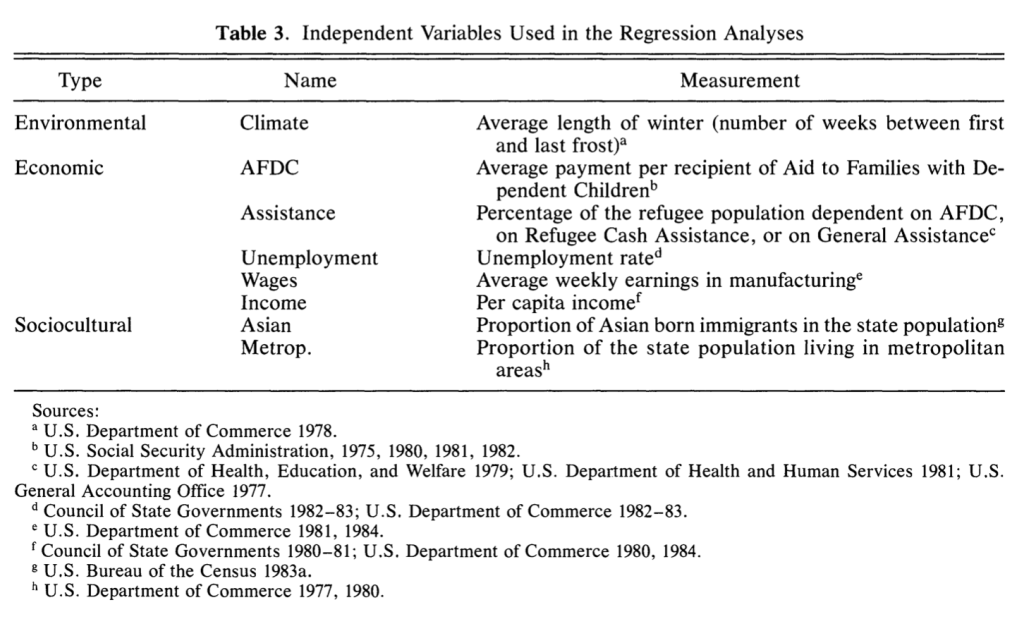
The why is summarized in the independent variables used in a regression analysis.
Desbarats (1985)’s independent variables for regression analysis, addressing Southeast Asian American locational choices.
In a follow-up paper, Desbarats (1986), quantitative analysis shows that statistically significant factors affecting moving changed over time. For example, in 1978 “average length of winter and average per capital income” (Desbarats 1986, 58) were statistically significant factors. 1979 results show the significance of two additional factors: “AFDC benefit levels and density of Asian immigrants” (ibid, 58), while 1980 saw the loss of significance of all of these factors, with the exception of AFDC (ibid, 58). However, also in 1980, “additional explanatory factors emerged, such as manufacturing wages, metropolitan population, and the proportion of refugees on assistance, a surrogate measure for ease of eligibility” (ibid, 58).
Of course, only partial inferences can be made about migration based on this data. I’m curious about how to think about this kind of study as fundamentally different from interviews data, where we could ask each person where they moved and why. Of course, multiple methods are needed when studying a social science question such as this one, and a pragmatic philosophy—in this case, for rejecting federal dispersion policy—grounds the research. I believe we can debate this, in an interplay between Harvey and Massey-like arguments, like the one I briefly mention at the beginning of this post.
~What are your thoughts? Help me out in the comments below.~
Bibliography
Desbarats, Jacqueline. 1985. “Indochinese Resettlement in the United States.” Annals of the Association of American Geographers 75 (4): 522–38.
Desbarats, Jacqueline. 1986. “Special Section: Migration and Resettlement. Policy Influences on Refugee Resettlement Patterns,” Kroeber Anthropological Society Papers, Kroeber Anthropological Society Papers 65-66: 49–63.



 Minh Q. Nguyen, PhD, MPP